Freshwater Sponge
Freshwater Sponge - Spongillidae
Freshwater sponges can appear in several shapes, including cushion like growths or large colonies with branching finger-like extesions. Each sponge is a colony of individual cells working together like a single organism. Inside the colony, cells specialise in various tasks - such as food capture, food processing or providing the colony with a structure in the form of a network of collagen fibres and siliceous 'spicules'. The green coloration of some colonies comes from small green algae living with the sponge, which provide some nutrition to the sponge, but sponges growing in shade are cream or brownish in colour and rely on food filtered out from the water.
Identification to species is very difficult, requiring microscopic examination of the spicules by an expert.

Photograph the sponge in its habitat
Freshwater bodies, including canals, ponds, flooded quarries and rivers, on a solid substrate such as rocks, masonry, submerged timber and tree roots. Canal walls, lock-gates and 'bridge holes' - the bricklined channels under bridges - may be a good place to look.
Colonies grow in spring, maturing in summer then usually disintegrating over winter. Freshwater sponges survive the winter through 'gemmules' - small packets of sponge tissue protected by a shell of hard material. Gemmules are resistent to freezing, drying out and darkness, germinating in spring to form new colonies. Reproduction can also be sexual; eggs (oocytes) are formed inside the sponges, and sperm is released into the water where they may end up fertising the oocytes in another sponge. The young are free-swimming planktonic larvae which disperse to form new colonies.
Freshwater sponges are micro-habitats, playing host to many invertebrates including some species of lacewings, caddisflies, midges and mites. The larvae of lacewings in the Sisyridae family, Sisyra or 'sponge-flies' are obligate sponge-feeders. The larvae of the caddisflies in the genus Ceraclea also feed on sponges, and may use the spicules or sponge fragments to make their cases - and so may assist in dispersal of sponges. There is much more on this aspect of sponge ecology in Jonathan Briggs' excellent paper in British Wildlife - see reference below.
Rarely recorded
Rarely recorded
Briggs, J. (2023) Freshwater sponges: our native species and their inhabitants. British Wildlife 35(2) 105 - 114. This is a very interesting paper, and most of the information above stems from it.
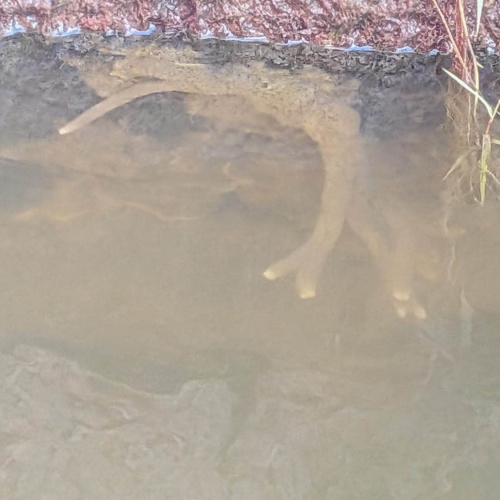 Beth Fox
Wistow, Leicestershire
22 July 2026
Leicestershire & Rutland Map
Enter a town or village to see local records
MAP KEY:
Yellow squares = NBN records (all known data)
Coloured squares = NatureSpot records: 2025+ | 2020-2024 | pre-2020
UK Map
Additional images
No additional images available for this species.